WoW Investigations
Hamilton Pulsar P1 (1972) – Elvis’s watch that cost half a car
The Hamilton Pulsar P1 (1972) was the first commercially available LED watch, which at its launch cost more than half the price of a new car.
In the history of watchmaking, there are moments that do not merely involve improving existing technology, but rather signify a genuine shift in the boundary between eras, sometimes even between price points.
A moment when not only the method of timekeeping changes, but also the way of thinking about the watch itself as an object, and the premiere of the Hamilton Pulsar P1 in 1972 was precisely such a moment.
It was not the first quartz watch in history, as that title belongs to the Seiko Astron 35SQ, which went on sale at the end of 1969 and initiated a technological revolution in time regulation using a quartz oscillator. A revolution whose effects we feel to this day.
However, the Astron remained an analog watch in its display, as it had hands, a dial, and a form that still resembled a classic timepiece.
The Pulsar did something far more radical and removed everything from the watch that had defined its appearance for several centuries. There were no hands, no dial that we were accustomed to, and not even a date window.
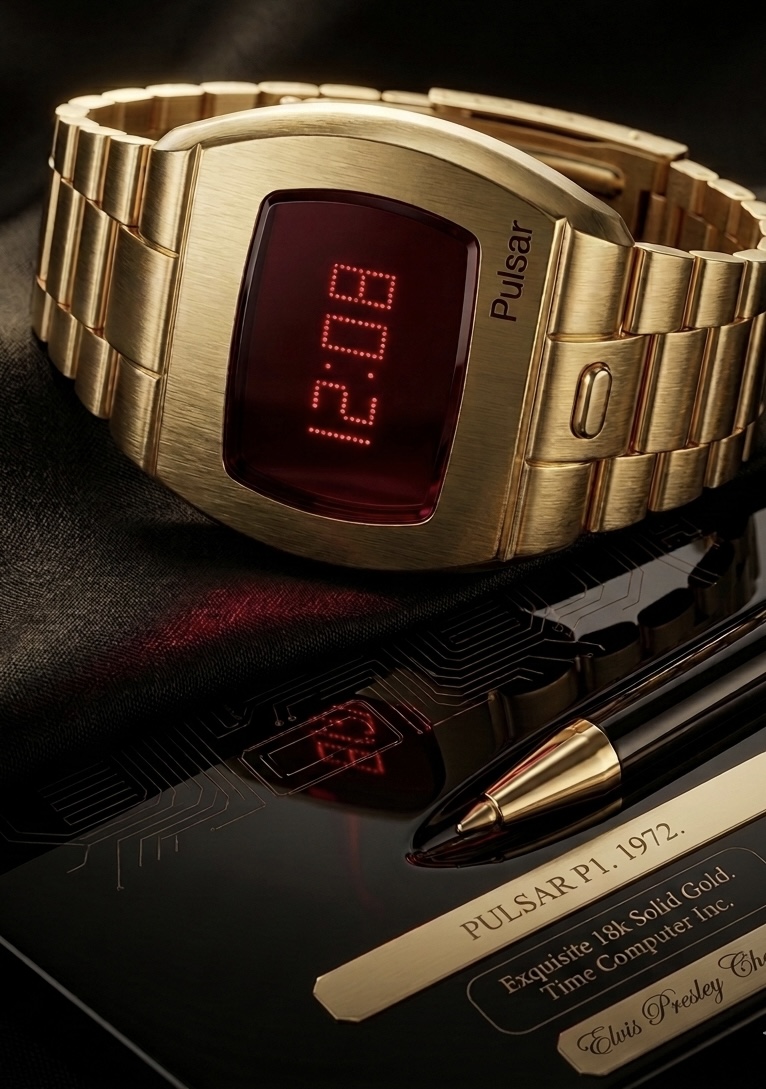
Instead, red LED digits appeared, which lit up for a few seconds after pressing a button, and at the time, it looked less like a watch and more like a piece of electronics transplanted directly from a science-fiction film.
A Watch That Was, by Origin, a Computer
The Pulsar project emerged at the intersection of two technological worlds that, just a few years earlier, had operated completely independently. The first was the Hamilton Watch Company, an American firm with a long watchmaking tradition that had produced precise railway and military watches since the late 19th century, and the second was the electronics company Electro/Data Inc., specializing in integrated circuits and digital systems.
This collaboration resulted in a project that, from the outset, was intended to be completely different from a classic mechanical watch. The Pulsar was to be a solid-state device, a watch devoid of any moving parts responsible for time indication. Thus, time was no longer indicated by hands driven by rotating gears, but calculated by electronics and presented in digital form.
In practice, this meant the birth of the watch as a technology interface, rather than a miniature mechanical machine.
Why Did Time Appear for Only a Few Seconds?
The most characteristic feature of the Pulsar was the necessity to press a button to see the time. Today, this might seem strange, but it resulted from the technological limitations of the era, as the LEDs used in the first half of the 1970s were extremely power-hungry. If the display were constantly lit, the watch's battery would drain in just a few hours!
Therefore, it operated in an "on-demand display" mode, where a short press of the button showed hours and minutes, and a longer press showed seconds.
This was a compromise solution that simultaneously emphasized the futuristic nature of the watch; time was no longer something we constantly observed on a dial, but information we summoned from the device.
Technological Luxury Instead of Cheap Electronics
The paradox of the Pulsar was that, contrary to intuition, it was not introduced as a cheap electronic gadget. Hamilton opted for the exact opposite strategy, and the first Pulsar was a luxury watch.
The case was made of 18-karat gold, as was the distinctive integrated bracelet, and the watch was sold exclusively in selected jewelry stores, including Tiffany & Co. and Neiman-Marcus boutiques.
The first production batch numbered only about 400 pieces, which further emphasized the exclusive nature of the product, just as limited edition watches do today.
A Watch More Expensive Than Most Luxury Timepieces
The price was $2,100, and to fully understand its scale, one must look at the economic realities of the early 1970s.
In 1972, the average price of a new car in the United States was about $3,800–$4,000, so the Pulsar cost more than half the price of a car.
Adjusted for inflation, this is equivalent to approximately $16,000 today.
Elvis Presley and 1970s Futuristic Jewelry
One of the first owners of the Pulsar was Elvis Presley, who bought one of the first P1 models shortly after its release.
This was no coincidence. In the 1970s, Presley surrounded himself with objects that were meant to emphasize his fascination with modernity and luxury: gold Cadillacs, extravagant jewelry, and the latest electronics, and this Pulsar fit perfectly into his world.
In an era when most watches still looked as they had half a century earlier, a gold watch displaying time with red digits looked like a piece of the future.
The Last Phase of Luxury Electronics
However, the story of the Pulsar does not end with the P1 model. Three years later, Hamilton introduced an even more extravagant model, the Pulsar Calculator Watch (1975), which I discuss in more detail in another article in this section.
The watch, equipped with a miniature keyboard and calculator function, cost about $3,950, almost twice as much as the first Pulsar.
Only later did something happen that almost always occurs in the history of technology: electronics began to rapidly decrease in price. LCD displays, consuming significantly less energy, appeared, and electronic companies producing watches in huge series entered the market.
By the end of the 1970s, digital watches no longer cost thousands of dollars, but merely tens or dozens.
WoW Conclusion
The Hamilton Pulsar P1 was, in essence, a transitional product between two worlds.
On the one hand, it still belonged to the era of luxury jewelry watches, where a gold case and limited production were part of its prestige, but on the other hand, it heralded a future in which the watch would cease to be primarily a movement and become an electronic device.
That is why the 1972 Pulsar cost half a car, and why just a few years later, a digital watch could be bought for the price of a dinner.