WoW Investigations
Gondolo Gang or Patek on the Brink of Bankruptcy
Retailer that sold one-third of Patek Philippe's production and almost dragged Geneva to its demise. The full story of Gondolo & Labouriau, from club lottery to trademark registration.
Brazilian Narcotic: How Gondolo & Labouriau Built and Nearly Buried Patek Philippe
At the turn of the 19th and 20th centuries, Patek Philippe's most important client was not in Geneva, Paris, or New York.
He was in Rio de Janeiro, wearing a straw hat and organizing illegal lotteries.
At its peak, the Gondolo & Labouriau trading house sold about one-third of the esteemed manufacture's annual production. Then it collapsed, and in the background of that collapse were pawn pledges, a coffee market crisis, currency depreciation, a panicking crowd, and police outside closed doors.
This is not a story about beautiful watches, but a story about one company's addiction to a single market, and what happens when that market disappears.
The Man Who Declared Himself an Agent Without Goods
Patek already had a representative in Brazil in 1849. This was Edouard Meyrat, the imperial court watchmaker in Rio. Meyrat died in 1859, and his family closed the business, so until 1861, advertisements for these Genevan timepieces disappeared from the press.
Emilio Joani Gondolo attempted to fill this void. An Italian from Sardinia, he apprenticed in Joseph Thaddeus Winnerl's Parisian workshop, at Carrefour de l’Observatoire, one of the pioneers of the rattrapante.
He arrived in Rio in 1844, but waited a decade for his own shop, and only on May 5, 1855, did he announce the opening of his "new and grand watchmaking and jewelry agency" at Rua da Candelaria 12A, two blocks from the imperial Paço Imperial, where Dom Pedro II resided.
Fourteen years later, Emilio did something as audacious as it was a complete fraud.
On May 12, 1869, after a thorough renovation of the flagship store, he declared himself the exclusive agent for Patek, Philippe & Co. for the entire Brazilian Empire.
The problem was that no one had authorized him to do this, nor had he agreed to it or signed any contract, so on November 15, 1869, Patek Philippe published a denial in the Jornal do Commercio.
The company stated that it was astonished by Gondolo's advertisements, as it had never sent him a single one of its watches. The dreamed-of partnership with Geneva did not materialize during Emilio's lifetime, as he took his own life on January 5, 1885, at the age of 52, but the name Gondolo only appeared on Patek Philippe dials through his younger brother Carlo, a few years later.
The Brother Who Secured a Great Partnership Without Fanfare.
The contract was finally secured by the younger brother, Maggiorino Carlo Antonio Gondolo, known in Brazil as Carlo, who separated from Emilio in 1871 and began operating independently.
He likely reached an agreement with Patek that same year, and the first batch of watches arrived aboard the steamer Mendoza, which Carlo announced on December 22, 1874. Without fanfare or ostentation, simply in a small newspaper advertisement.
The difference in method is stark, as what Emilio announced as a partnership he didn't have, Carlo actually secured and mentioned in passing.
Carlo's workshop repaired watches on an industrial scale. From 1871 to 1914, over 134,000 pieces passed through his establishment. The record year was 1913, with an impressive 9003 watches, which translates to about 28 per day, counting 6 working days a week.
Marriage, Merger, and a Registered Brand
Success came with the merger with the French Labouriau family. The son of jeweler Ferdinand Labouriau, Paul Henrique, married Carlo's daughter, Carlota.
On July 1, 1891, Carlo announced the admission of his son-in-law to the company, and thus Gondolo & Labouriau was formed at Rua dos Ourives 123.
On August 21, 1893, the partners registered the brand Patek, Philippe & Co. in the Brazilian trademark registry, thereby securing their position formally, not just commercially. I know this sounds strange in light of today's trademark law, but such were the realities of the 19th century.
The Club System and the Lottery That Sold Watches
Brazil was then experiencing a boom in coffee, rubber, and sugar. A wealthy agrarian oligarchy emerged, which also needed a way to demonstrate its financial status, and Gondolo & Labouriau provided an excellent tool in the form of "Clubs Patek Philippe."
The mechanism was clever and resembled group purchases familiar from our realities, though spiced up with the thrill of gambling.
Each member paid a fixed weekly installment, and a weekly draw selected one winner who received a watch immediately and was exempt from further payments. The trick was that in this system, there was no single unlucky person. The standard club variant had 180 members, but the cycle lasted 74 weeks with an installment of 10 francs. This meant that in the final, 74th week, a large group of "unlucky" people remained – as many as 107 individuals. All of them paid their last installment and collectively picked up their watches at the full retail price of 740 francs. The distributor had cash upfront from day one, and the client bought a chance for a stroke of luck.
The trademarks Gondolo, Chronometro Gondolo, and Clubs Patek Philippe were registered in September 1901, and the official regulations were published in the famous trade guide Almanak Laemmert in 1902.
From a legal standpoint, Gondolo & Labouriau walked a fine line. The Brazilian code at the time severely treated gambling and private lotteries. However, the trading house employed a clever legal trick: since every participant ultimately ended up with a watch in their pocket, the system was advertised not as gambling, but as a specific, cooperative form of installment agreement with a bonus. The state turned a blind eye for years – and it's hardly surprising, given that judges, ministers, and agrarian oligarchs participated in the clubs.
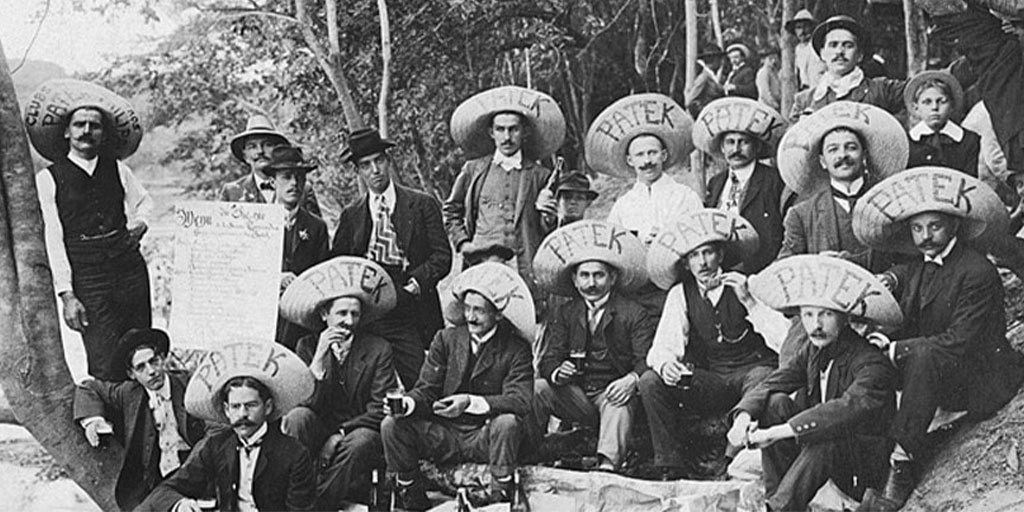
Members of these exclusive associations eventually earned their own proud name: the Gondolo Gang. Their distinguishing mark became identical straw hats with a large, embroidered PATEK inscription. Weekly draws turned into lavish picnics and social banquets, and to heighten the atmosphere, an occasional piece was even composed – "Patek Waltz" by F. Santini. Thus flourished the most audacious installment sale in history, masterfully disguised as the elite social life of Rio de Janeiro.
At its peak, Gondolo & Labouriau was probably the most profitable watch retailer in the world, and the word "Patek" entered common Portuguese parlance as a synonym for a luxury watch, even overshadowing Tiffany & Co.
Chronometro Gondolo, or Engineering Designed for the Climate
Watches traveling to Rio had to withstand truly tropical humidity. Brass corrodes in such conditions, so in 1902, Gondolo & Labouriau ordered a dedicated series with a going train using gears made of 9-carat rose gold. Gold does not oxidize, so the watch's rate was intended to remain more stable. The finishing of these movements also had marketing significance.
From about 1910, with the fashion for wristwatches, geometric cases appeared: rectangular, square, tonneau, and cushion-shaped. Large for the era, reaching up to 48 mm with the lugs. The owner's status had to be visible from afar.
The Sterns Enter in 1932, Before Brazil Finally Collapsed
The Great Depression hit the Swiss watch industry mercilessly. Exports fell by 59 percent, and by 1932, Switzerland's production and national income hit rock bottom. Patek found itself in a difficult financial situation and turned to its dial supplier, Stern Frères. In 1932, Charles and Jean Stern acquired the manufacture. The production of the Henry Graves Supercomplication in January 1933 for 60,000 francs further stabilized the company marketing-wise and somewhat financially.
The Sterns bought Patek in response to the global crisis and the collapse of Swiss exports, and the Brazilian market was one of the factors weakening the manufacture throughout the 1920s.
The Pawn Scandal, or How a Retailer Cheated His Own Customers
After World War I, G&L was managed by Guilherme Decourt, the main shareholder. The 1920s brought mass production and difficult times for luxury, and the Wall Street crash in 1929 also plunged coffee prices, and Brazilian trade collapsed. In 1930, a revolution came.
However, the roots of the disaster ran deeper, as Carlo Gondolo, in his heyday, squandered profits on real estate and a luxurious life, instead of transferring payments to Geneva. After his death, Paul Labouriau discovered a hidden gigantic debt to Patek Philippe amounting to 700,000 Swiss francs. Together with Decourt, he reduced it to 80,000 francs, but died of a heart attack on February 9, 1933.
Then something worse began to happen. In late 1934, clients began to complain about monthly delays in the return of watches given for repair. The reason only came to light during the collapse, as Decourt, cut off from bank credit, had been secretly pawning entrusted watches in pawnshops in Rio and São Paulo since 1932.
These were mainly valuable Patek pocket watches. When a client firmly demanded their piece, Decourt would buy it back and replace it with another, or issue fictitious receipts. This operated like a classic Ponzi scheme, only with other people's watches.
One pawnshop held over 150 client watches in its safe. The total loan against this collateral was about 154 so-called contos de réis (154 million réis).
Due to the catastrophic drop in the Brazilian currency's exchange rate, this pile of money was worth only about 43,000 Swiss francs in Geneva. Pawnshops ruthlessly exploited the situation and acquired the most valuable movements for a fraction of their real value, while Gondolo's debt to Patek Philippe already exceeded 170,000 francs.
Closed Doors and Legal Checkmate
On May 7, 1935, Decourt fell ill, and the final nail in the coffin proved to be uremia and advanced atherosclerosis. He was admitted to São José clinic in critical condition. Rumors of a suicide attempt spread through the city. Decourt actually died on May 24, which disproved the rumor, but did not stop the panic.
Alfredo Avilez became the interim manager. He tried to negotiate with the pawnshops for the return of the watches without immediate repayment.
Unsuccessfully, as on Saturday, May 18, 1935, at 11:30 AM, he closed the salon doors under the pretext of a lunch break. They never opened again.
An angry crowd gathered outside the shop. The last Patek Philippe Club abruptly stopped 15 weeks before the finish line. At this point, the legal guillotine was activated. As the police intervened, the government immediately revoked the company's license to operate clubs. Avilez was trapped, as he could no longer conduct another draw, nor could he release the watches (because they were in safes), and failing to complete a licensed cycle automatically turned the prestigious business into a crime of fraud and illegal gambling in the eyes of the law. No bank wanted to talk about saving the company with someone the prosecutor's office treated as an illegal casino operator.
The investigation revealed 396 receipts from 15 different pawnshops.
The court approved the bankruptcy on June 12, 1935. The company owed European suppliers over 170,000 francs, the lion's share of which went to Patek.
What Remains
From the perspective of luxury brand management, this story is textbook. An innovative installment model and aggressive marketing created demand that financed Patek Philippe's development during a difficult era. This same model made the manufacture's liquidity dependent on one distant partner.
The concentration that builds is the same concentration that kills.
This was compounded by Brazil's structural insolvency in 1927–1930, which was also one of the key reasons why Patek was on the brink of bankruptcy in 1932.
Patek survived because the Sterns entered somewhat earlier and for a different reason. If the Brazilian market had been the sole pillar, and the 1935 crash the only support for a change of ownership, this brand would not exist today.
In 1993, Patek Philippe introduced the Gondolo collection. A line of watches with non-round, rectangular, tonneau, square, and cushion-shaped cases, referencing pre-war wrist models from Rio and the Art Deco aesthetic.
The name of the most profitable and riskiest retailer in the brand's history now appears on dials, which are connected to the Brazilian boom only by geometry.
The retailer disappeared, but the word remained.