WoW Investigations
George Daniels. A hundred years later
He built few watches, but he changed the way we think about watchmaking. On the hundredth anniversary of George Daniels' birth, through his story and the personal recollections of Roger W. Smith, we revisit the man whose ideas live on.
A Hundred Years.
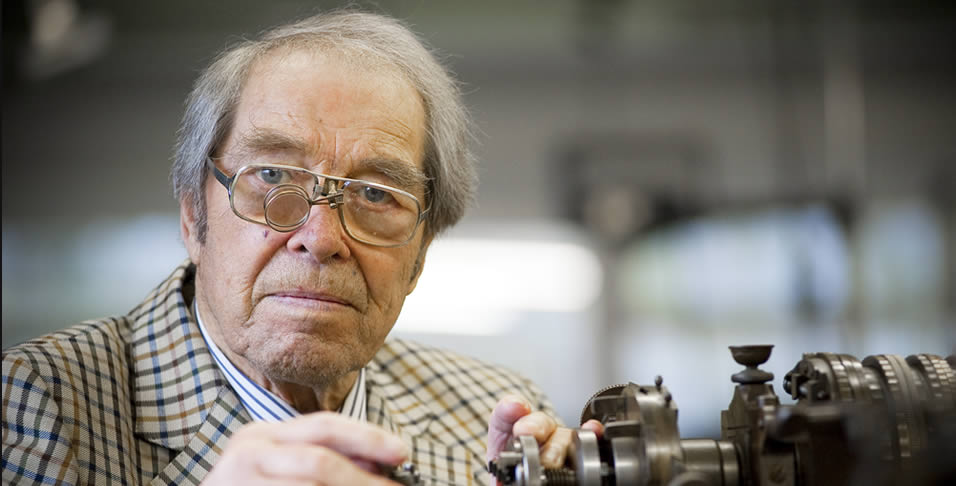
George Daniels was born exactly on August 19, 1926. If he were alive, he would be celebrating his hundredth birthday today. On this occasion, Roger W. Smith published a personal memoir about his master, returning not only to his most important constructions and inventions, but also to the man he first admired from afar, then met, and finally worked alongside for years before becoming a master himself, who, I hope, will find his successors.
I read this text with particular interest. George Daniels is one of the protagonists of my recently published book WoW – Watcher of Watches, and Roger W. Smith is one of the watchmakers I interviewed for it. Today, a hundred years after Daniels' birth, these two stories connect in a way that allows us to look at his legacy not only through the prism of what he created, but also what he left behind in the way others think.
In his memoir, Roger recalls a scene from 2006, when a retrospective exhibition of Daniels' work was being prepared at Sotheby's. Before the watches were placed in display cases, his life's work lay on two foam-lined metal trays the size of an A4 sheet.
Twenty-four pocket watches and two wristwatches.
Twenty-six watches, behind which stood one of the greatest influences on contemporary watchmaking.
This comparison is particularly telling today, when we so easily measure a manufacturer's greatness by the scale of its turnover, margin, number of references, launches, boutiques, and units sold. Daniels shows how little the number of items produced can have in common with the significance of their creator. As Smith notes, few watchmakers have created so little while influencing so much.
From a Poor Boy to a Master
When I wrote the text about Daniels in Watcher of Watches, I placed him in the section titled "Forgotten Heroes." Of course, he is not a forgotten figure by those truly interested in watchmaking, but outside that circle, the situation is different. Millions of people know the "Co-Axial" inscription on Omega dials, far fewer know who the man behind this invention was.
And his life story is as interesting as his watches.
Daniels was born into a poor, large family. He had to start working very early and just as early understood that knowledge could be a way for him to escape the world he grew up in. He was interested in mechanics, repaired watches, earned money during his military service by doing repairs for colleagues, and later invested in tools and his own workshop. At the same time, he read, learned, and gradually entered the circles of collectors, historians, and people who could open up a world previously completely inaccessible to him.
One of his great fascinations became Abraham-Louis Breguet. Daniels not only collected and restored his watches, but over time grew into one of the foremost experts on his work, as evidenced by his book The Art of Breguet.
His second great love was cars. And it was thanks to them that he met Cecil "Sam" Clutton, a collector, historian, and expert who played a significant role in his further journey. It was Clutton who convinced Daniels that he should create his own, hand-made watches. Together, they also wrote Watches – a book to which Roger Smith returns in his memoir today.
Not by chance.
Smith points out that it contained over fifty illustrations of the escapements known at the time. However, Daniels was not interested in them solely as a historian. He wanted to understand why they worked, where their weaknesses lay, and if they could be eliminated.
This distinction says a lot about him.
Don't Improve the Problem. Solve It.
Already in his first pocket watch, completed in 1969, Daniels modified the geometry of the chronometer escapement, creating its self-starting variant. This was not the end of his quest. He became increasingly interested in the fundamental problem of the classic escapement and its dependence on lubrication.
Instead of asking how to better deal with an existing limitation, he began to wonder if the limitation even needed to exist.
This path led to the creation of the Co-Axial escapement.
Today, Co-Axial is one of the most recognizable technical terms associated with Omega. The brand introduced it into series production in 1999 and eventually made it one of the foundations of its technical identity. Looking from today's perspective, it's easy to forget how long Daniels tried to interest the Swiss industry in his solution and how much skepticism he encountered along the way. Fortunately, he also met people who led to the commercial success of selling and implementing Daniels' invention, such as Derek Pratt and Kilian Eisenegger.
The story, therefore, looks completely different from the classic tale of an inventor whose brilliant idea is immediately recognized by industry. For years, Daniels convinced people with incomparably greater technical and financial resources that one of the basic elements of a mechanical watch could be made differently.
In the end, they adopted his solution, not the other way around.
Daniels as Seen by Smith
The most interesting part of Roger's text for the master's centenary, however, is not another reminder of the Co-Axial story. Much more interesting is what Smith, after several decades, considers to be the essence of Daniels' way of thinking.
He writes that when he analyzes his watches, drawings, and working methods today, he is still surprised by the master's readiness to rethink problems that everyone else had already accepted. He possessed the intellectual courage to dismantle conventional thinking and start from scratch if he believed it was leading in the wrong direction.
This theme was particularly strongly emphasized in my conversation with Roger W. Smith as well.
When I asked him about contemporary watchmaking's fascination with exotic alloys and silicon, he replied that materials like brass and steel have hundreds of years of practical testing behind them. We know how they age, we can machine and repair them, and a watch made using them can remain serviceable for future generations.
Then he said something much less popular. New materials do not always solve the problem. Sometimes they only help to mask the mechanical inefficiency of an existing design. And it was at this point that he invoked Daniels, who did not try to improve a flawed escapement by using a material with more favorable properties, but instead tackled the design itself and created the Co-Axial escapement.
At another point in our conversation, Roger spoke directly about the "Daniels Method," a working method according to which his workshop manufactures almost all watch components in-house, with clearly defined exceptions. For Smith, this is not a marketing ploy to put the magic word in-house on a website. It's about preserving skills, controlling the design, and the ability to design and manufacture components without subordinating one's own ideas to what the industry can currently offer.
Interestingly, the same man who continues Daniels' method also believes that isolation from the Swiss ecosystem proved to be an advantage for him. Roger told me that as a young watchmaker, he wondered if the lack of a Swiss education was a mistake. Years later, he came to the opposite conclusion. He was not shaped by existing patterns and had to learn to think independently.
The similarity to Daniels is not hard to find.
The Man Behind the Watches
In his anniversary text, Roger also shows a Daniels that we won't see in auction descriptions.
He first met him in 1987, when Daniels visited the watchmaking school where Smith was studying. He remembered his three-piece pinstripe blue suit, perfectly polished black shoes, and a man who, by his mere presence, could impose his personality on those around him.
Later, for seven years, Daniels' Watchmaking accompanied Smith as he worked on his first two pocket watches. When he entered the master's workshop on the Isle of Man in 1998 to begin work on the Millennium Project, he felt as if he had entered a three-dimensional version of the book he had studied for so many years.
Daniels had a reputation for being difficult. Roger interprets this somewhat differently years later. His master had no patience for people wasting time and expected others to meet standards similar to those he imposed on himself.
But there was also another Daniels, easily lost under the weight of the legend of the great watchmaker. A man with a dry sense of humor, in love with cars, his Bentleys and a 1932 Alfa Romeo 8C. Roger recalls joint trips to The Grosvenor pub in Andreas, where Daniels drank Okell's and ordered fish and chips, which he called "whale and chips."
I like this part of Smith's memoir, because after the death of eminent people, we have a terrible tendency to reduce them to monuments. Achievements, dates, awards, auction prices, and photographs taken at the workshop remain. The man disappears.
In Daniels' case, this would be particularly unfair. He was a watchmaker, constructor, and inventor, but also a writer, collector, enthusiast and driver of vintage cars, and a classic self-made man who went from a very poor childhood to a place in watchmaking history.
What Exactly Did He Leave Behind?
And it is here that Roger Smith reaches the most interesting conclusion in his memoir.
After more than forty years of studying Daniels' work and years spent by his side, he believes that the master's greatest achievement may not have been the most obvious one at all.
Not one of the twenty-six watches. Not the Space Traveller. Perhaps not even the Co-Axial.
Roger writes:
"George made other people care about what he was doing."
Daniels did not confine his knowledge to the workshop. He wrote books, gave lectures, made drawings, described methods, and explained why, in his opinion, certain watchmaking problems should be solved differently. Smith now believes that this ability to explain, educate, arouse curiosity, and force others to think more deeply may have been as important as the watches he left behind.
Roger W. Smith is perhaps the best proof that Daniels succeeded.
Not because Smith makes the same watches. Quite the opposite, Roger has his own aesthetic, his own constructions, and his own answers. During our conversation, he spoke about designing a watch from the complication and dial layout, about his own three-dimensional hands made in the workshop, about seeking a solution to the problem of traditional date indication, about the durability and serviceability of the movement, and about how his watches should be passed down from generation to generation.
I will not elaborate on all these threads here. The full conversation with Roger W. Smith is included in WoW – Watcher of Watches, and it is there that it is worth reading in its entirety.
What is more important in the context of Daniels' hundredth birthday is something else. A good master should not leave behind copies of himself. He should leave behind people he taught to think independently.
Two Trays
So I return to the image where this story began.
Two metal trays at Sotheby's. Twenty-six watches.
In the modern luxury industry, we almost automatically equate success with growth. More products, more launches, more customers, greater production, greater turnover, and ultimately greater profit, in pursuit of which corporations lose brand identity, personal relationships with customers, or the artisanal spirit. Because the latter is definitely too expensive.
Daniels is almost an absurd case in this regard. He created very little materially in terms of pieces, yet he left behind an enormous amount.
In WoW – Watcher of Watches, I wanted to tell about watches precisely through such stories. That's why, alongside movements, brands, the market, collecting, and phenomena of the contemporary watch industry, there was a place for "Forgotten Heroes," among whom I described George Daniels, and for conversations with people who truly create contemporary watchmaking. Roger W. Smith is one of them.
The book premiered in a limited edition on June 21, the summer solstice, and the regular version is now available at wowbook.pl. For now, the Polish version.
A hundred years after George Daniels' birth, we can, of course, remember his watches, the Co-Axial, his books, cars, and extraordinary life journey. But after reading Roger Smith's text, I am increasingly convinced by another measure of his greatness.
George Daniels died in 2011. His way of thinking did not.
And perhaps that is what true watchmaking heritage is all about.
photographs: George Daniels. Source: Daniels London and courtesy of Roger.W.Smith