WoW Investigations
Does Sinn copy Breitling? The untold story
Is the Sinn 903 a Navitimer fake, or a legitimate continuation of the design?
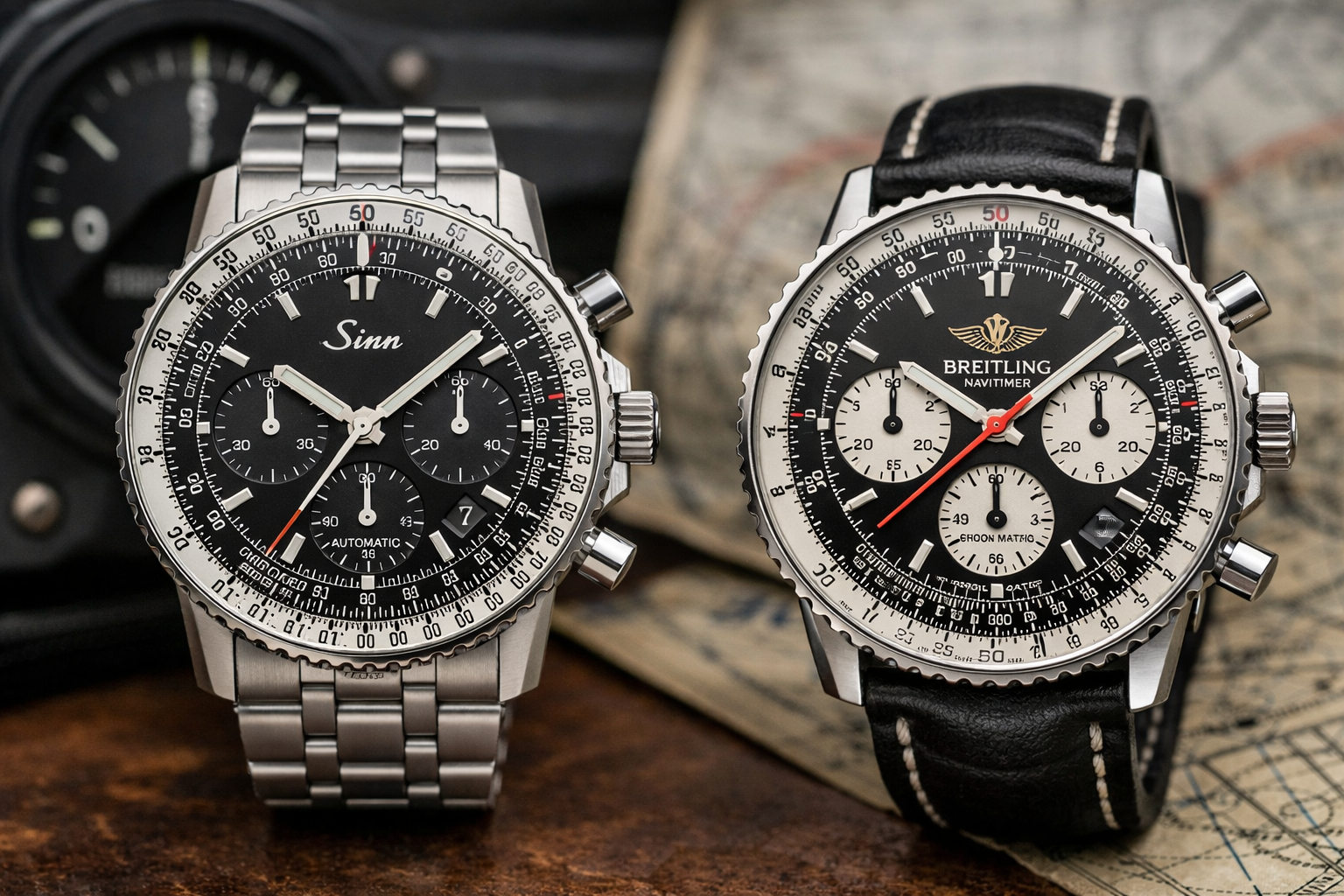
An accusation that sounds impressive but is an obvious untruth.
The topic of fakes and inspirations is an evergreen discussion, both in groups, forums, and everyday life. Pointing out the astonishing similarity of various brands to a desired model of another brand, and trying to prove who was really first, as well as why it's not a copy but an inspiration, is the "salt of the earth" for enthusiasts' discussions. But there is an example that somewhat eludes all these definitions and analyses, and often, unfortunately, is lumped together with others. This is the example of the German brand Sinn and the 1:1 Breitling Navitimer model.
But this accusation of copying is based solely on the visual similarity of the Sinn 903 model to the classic Navitimer, completely ignoring the legal, economic, and historical context in which this watch could even exist.
Because this is not a story of inspiration or copying, but a story of bankruptcy, asset sales, and project acquisition.
1979: when a legend becomes insolvent
To understand the genesis of the 903 model, one must go back to the late 1970s, when the quartz crisis led many Swiss manufacturers to financial collapse, including Breitling, which declared bankruptcy in 1979, ending a chapter of its history and beginning the process of selling off technical assets, documentation, and production tools. The brand itself was eventually sold to Ernest Schneider, but before that happened, Breitling was getting rid of everything that could bring in much-needed cash.
It was at this moment that Helmut Sinn, a former pilot and founder of the Sinn company, made a move whose effect is today sometimes interpreted as "copying," whereas in reality, it was a classic acquisition of technology under market conditions.
Sinn acquired the rights to produce the Navitimer's design, along with tooling and spare parts.
So Sinn didn't redraw it from scratch and didn't try to pretend it was his design.
He simply bought it legally.
The Sinn 903 is an heir, not a copy
The Sinn 903 model, which still stirs emotions today, is a direct successor to the Navitimer references 806 and 809, and its visual similarity does not stem from inspiration, but from the fact that it is based on the same design architecture, acquired legally at a time when Breitling was no longer able to maintain it.
This is a fundamental difference, because a fake is an imitation without the right to the original.
Sinn had that right.
Moreover, it never tried to hide its own identity, as the Sinn logo, not Breitling, always appeared on the dial, and the brand did not build a narrative of "aviation heritage from 1952," but continued the watch's lineage as an instrument.
An inconvenient truth: who developed the design?
The irony of this story is that in subsequent decades, it was Sinn that introduced technical modifications improving the functionality of this design, including increased water resistance and improved material durability, while the Navitimer evolved mainly as an aesthetic icon, increasingly rooted in the world of luxury and symbolism, and less and less in the purely utilitarian world.
The contemporary Sinn 903 offers performance parameters that classic versions of the Navitimer long lacked, which raises the question not of who copied whom, but of who genuinely developed the project in the spirit of a watch as a tool, not as a story.
So why has the myth of the "fake" persisted?
Because for some, a brand's history begins when they discover it, not when it actually originated.
Breitling rebuilt itself in the 1980s under new ownership, successfully reconstructing the narrative of its aviation legend, while Sinn remained a austere, technical, and almost anti-marketing brand, which is why in the collective consciousness, Breitling is considered the "original" and Sinn the "imitator," even though for a certain period, Sinn was the sole producer of this design.
This is an example of how marketing, not history, shaped this perception.
So, does Sinn fake Breitling?
No. Sinn acquired the Navitimer project when its creator failed, and produced it legally under its own brand, without impersonating anyone, copying another's name, or falsifying identity.
If there is any controversy to be found, it is not in the question of "faking," but in whether the contemporary luxury market can accept the fact that history does not always proceed linearly, and a legend can sometimes be kept alive for a time by someone entirely different.