WoW Investigations
Did the Japanese save Tag Heuer?
The 1887 movement was supposed to be pure, manufacture, and "entirely ours." As usual, it turned out to be much more interesting.
Who Really Built Calibre 1887, or a Story the Industry Would Prefer to Tell Differently
There is a version of this story that can be effortlessly told to a customer at the counter of an elegant boutique, while showing them the new movement through the sapphire case back, pointing out the column wheel, talking about a return to roots, and very skillfully linking the caliber's name to the year 1887. This was the moment Edouard Heuer patented his oscillating pinion, one of those historical points for the brand that are perfect for building a narrative of continuity, heritage, and consistent development of proprietary solutions. The problem only arises when someone stops listening to this story and starts looking at the movement not as a piece of brand history, but as a technical construction which, like any other, has its source and a very specific genesis.
To understand this genesis, one must momentarily set aside one of the most widespread and convenient narratives in the watch world: the belief that we are dealing with a system of independent manufactures, each designing and producing their movements in almost complete isolation from the rest of the industry. In reality, for decades, a much more pragmatic model operated, where external suppliers, primarily ETA, played a huge role, and many brands built their identity and offerings based on movements that were then modified, finished, and appropriately presented to the customer.
This arrangement worked smoothly until access to these movements became less certain, and Nicolas Hayek's decisions to limit supplies gradually began to change the architecture of the entire market.
The ETA Shock.
This specific period in history was indeed a shock for many brands, and for TAG Heuer, it meant entering a situation where merely having history, recognizable models, and a strong marketing position was no longer enough. The most fundamental element was missing: its own independent source of chronograph movements, which is, after all, embedded in the brand's DNA.
Building such a caliber from scratch is a multi-year, costly, and significantly risky undertaking, requiring infrastructure that cannot be created overnight. At some point, the decision ceases to be romantic and becomes purely managerial. This is where a choice emerges that, from a technical perspective, was very sensible, but from an image perspective, potentially problematic.
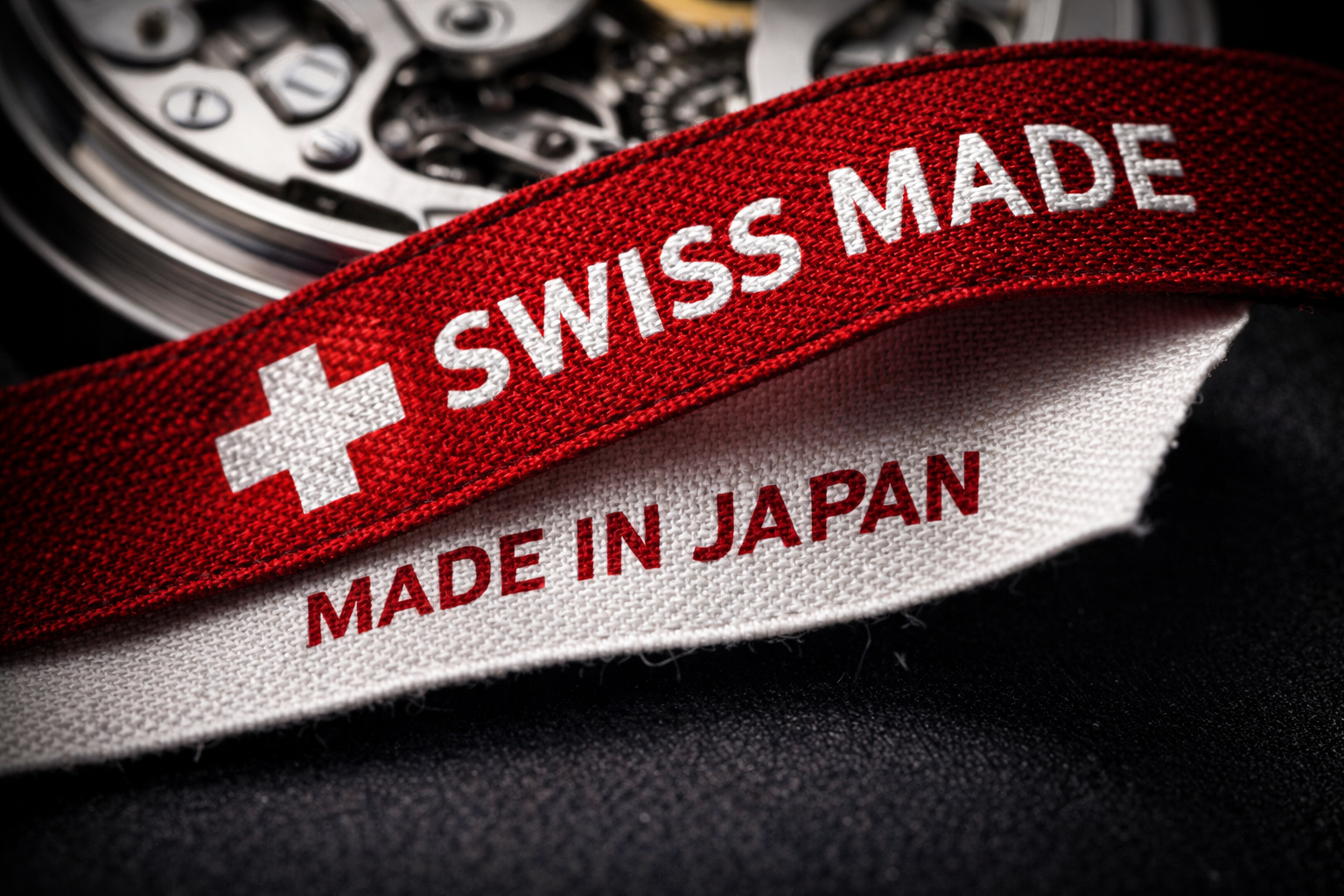
At that time, Seiko Instruments had the TC78 project, belonging to the 6S family, an integrated column-wheel chronograph, designed in a way that could be described as exceptionally consistent engineering. It was not a movement created for a marketing story, but in a Japanese manner, meaning primarily for functionality, durability, and manufacturing capabilities. In a world where complexity is often celebrated as a value in itself, this was a surprisingly "clean" construction in technical and logical terms. For TAG Heuer, it was therefore an ideal starting point, though at the same time difficult to reconcile with the brand's image as a producer of fully independent solutions. How could "Swiss Made" be reconciled with Japan?
The mere fact of acquiring the rights to this design was in no way compromising; on the contrary, it can be seen as a manifestation of very sober strategic thinking, as it shortened the development path by several years and allowed a proven architecture to be used as a foundation for building proprietary production capabilities. The problem only arose when this decision had to be communicated to the world, translating industrial reality into marketing language, which by its nature favors simplifications, clarity, and strong statements.
1887 Enters the Market.
The launch of Calibre 1887 in 2009 was a special moment in this regard, as it presented a movement that indeed represented a significant step towards the brand's independence, but it was described in an overly unequivocal way, suggesting complete design autonomy. In the realities of the modern market, where information access is instantaneous and the community of collectors and enthusiasts possesses vast technical knowledge, such a narrative was very quickly scrutinized. It took only a few days for comparisons of the new caliber's architecture with the Seiko 6S37 to emerge, and the similarities proved so striking that they could not be reduced to mere inspiration or accidental coincidence.
The reaction of TAG's CEO, Jean-Christophe Babin, was interesting in that, instead of trying to obscure the issue, he opted for a relatively open admission that the base project had been acquired from Seiko and subsequently developed by TAG Heuer. This statement, though logical and factual, nevertheless struck at one of the key narrative axes, as it directly showed that the line between "in-house" and "external origin" is often much more fluid than marketing materials suggest.
Is 1887 a Seiko?
The biggest oversimplification that still appears in this story is treating Calibre 1887 as a simple copy of a Japanese movement, which is a convenient interpretation but does not reflect the essence of the matter. Transferring a project from one industrial culture to another requires deep intervention in the design, adapting it to different machinery, different production tolerances, and different finishing standards. TAG Heuer changed the dimensions of the movement, redesigned the bridge architecture, adapted the production process to its own capabilities, and as a result created a construction that, although derived from a Japanese design, operates in a completely different technological context.
One of the most eloquent examples of this transfer of thinking is the Magic Lever winding system, adopted from Seiko, which in its simplicity and effectiveness is almost the opposite of many solutions designed primarily for prestige and visual appeal. It is a mechanism that does not try to impress with complexity, but with operational efficiency, which perfectly illustrates the difference between the Japanese and Swiss approaches, where the former often focuses on functionality, and the latter on aesthetics and tradition.
From the perspective of several years, it is clear that Calibre 1887 fulfilled its role, becoming the foundation for the brand's further development and enabling the building of its own production competencies, which resulted in subsequent constructions. At the same time, however, it remains one of the most interesting examples of the tension between industrial reality and marketing narrative, showing how difficult it can be to reconcile these two worlds.
Heuer 01
The subsequent transformation of the movement into the Heuer 01 under the leadership of Jean-Claude Biver was more about changing how the story was told than changing the construction itself. Biver, as a brilliant marketer who perfectly understood both market mechanisms and watch movements, shifted the emphasis from origin to perception, focusing on modernity, design, and the emotional reception of the product, which largely neutralized earlier controversies.
Ultimately, Calibre 1887 remains something much more interesting than just another movement in the brand's catalog. It is a case study showing that modern watchmaking does not operate in isolation, but within a global system where technologies, ideas, and solutions move between countries and companies, and success often depends not so much on the "purity" of origin, but on the ability to make the right decisions at the right time.
Rescue or Reason?
In this sense, the question of whether the Japanese "saved" TAG Heuer turns out to be somewhat ill-posed, because it was not about rescue in the classic sense, but about using an available solution as a starting point for further development. What for some may be an inconvenient fact, for others is proof that the true strength of a brand lies not only in building a narrative of its own uniqueness, but in the ability to adapt to changing conditions and use what is best at a given moment.
And perhaps that is why this story still evokes emotions, because it shows that behind elegant cases and meticulously finished bridges lies a much more complex world, where decisions are made not only at the watchmaker's bench, but also in boardrooms, and sometimes even outside the borders of Switzerland.