WoW Investigations
A surname is not enough. The short life of the TRIBUS brand
This is not a story about a fallen brand. This is a story about why the man who helped create Christopher Ward failed to create a second Christopher Ward.
When you believe you have the "Midas touch"
Three brothers, a father with a legendary name in the industry, a seven-figure contract with FC Liverpool, and multi-million funding.
It seemed TRIBUS had everything to succeed, but it lasted less than two years. This is a story about why the man who co-founded Christopher Ward failed to create a second Christopher Ward.
Father leaves, sons enter
On January 3, 2020, Mike France announced that Chris Ward – co-founder of the brand bearing his name – was leaving after sixteen years. The communication was corporately warm and did not foreshadow conflict. The background was less so, as a year earlier Christopher Ward had secured £6.25 million from the Business Growth Fund, and the control structure had changed, with France effectively running the business.
An owner without a real role in the company bearing his name, especially with an institutional investor, is a scenario that usually ends in conflict or separation.
One detail is worth remembering. The company that would become TRIBUS was registered on December 9, 2019, under the name Ward Brothers (Watchmakers) Limited. Almost a month before Chris's public departure announcement, so preparations, ideas, and decisions must have been made much earlier.
The founders were his sons: Jonathon (1988), James (1991, Managing Director), and Jake (2003, sixteen years old on the day of registration). Chris formally joined the board in February 2021, although he had been the "chairman" of the project from the beginning.
TRIBUS is Latin for "three," referring to the three brothers.
Launch with Anfield in the background
The brand launched on September 9, 2020, with a clear narrative: this is not another crowdfunding microbrand. WatchPro wrote about multi-million funding from a group of wealthy investors, reportedly Liverpool fans and collectors. The flagship "asset" was a five-year partnership with FC Liverpool and branding at the iconic Anfield stadium, theoretically reaching hundreds of millions of fans.
Chris Ward spoke directly about a seven-figure deal. Interestingly, discussions with the club began two years earlier and originally concerned… the Christopher Ward brand.
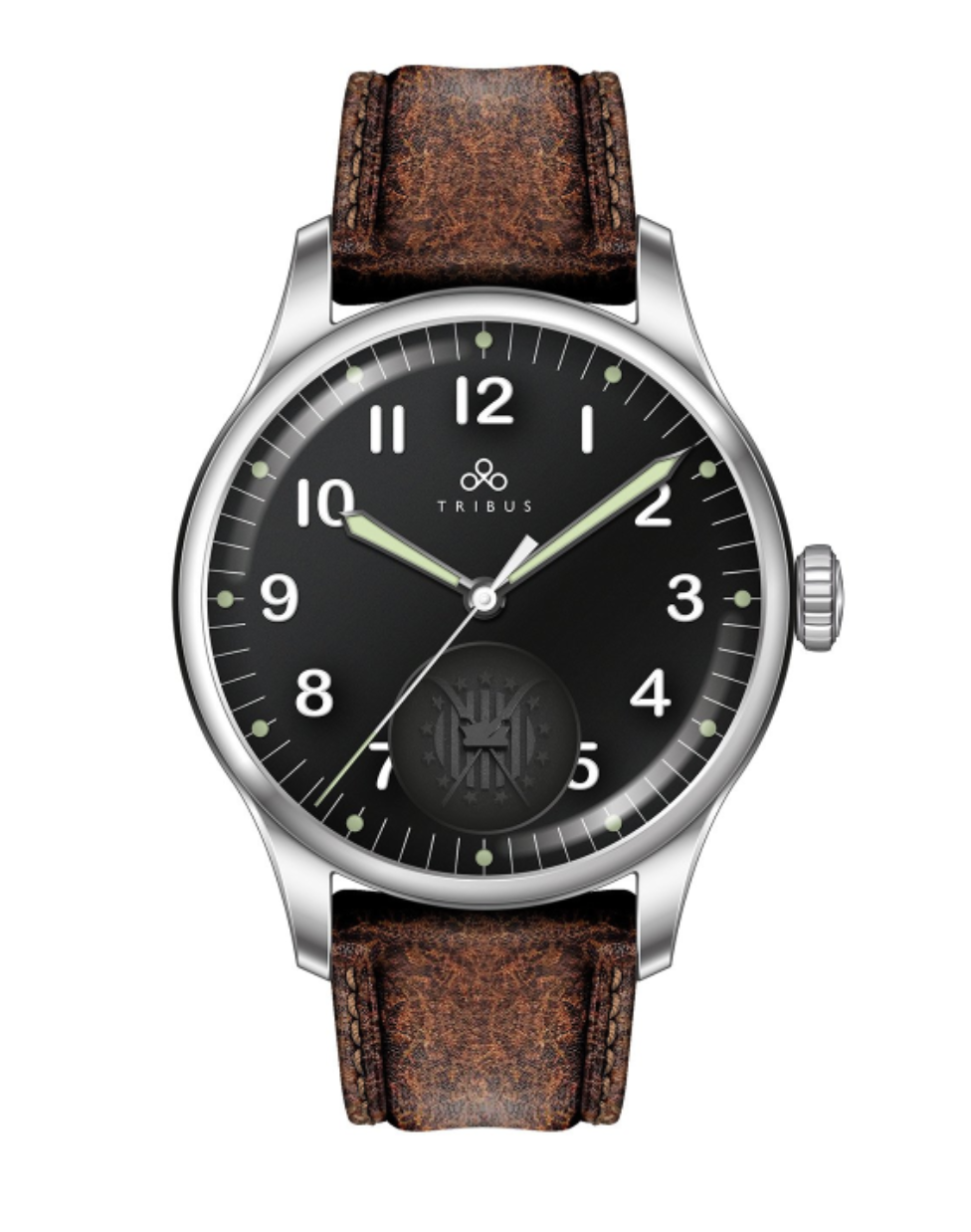
Product-wise, TRIBUS focused on classic designs. However, many models seemed to be an evolution of the aesthetic already well-known from Christopher Ward.
The build quality raised no major concerns, but the design was unremarkable. It was difficult to identify an element that would allow recognition of a TRIBUS watch without looking at the logo. For a company trying to sell watches in the £1300 - £2000 range, this was a much bigger problem than it might have seemed.
And a model that Polish readers should know.
Piotr Łaguna's Spitfire
TRI-05 303 Squadron P8331, a limited edition of 303 pieces, created with the Laguna’s Spitfire Legacy organization.
The watch contained a fragment of metal from Spitfire P8331 RF-M "Sumatra," a machine belonging to Squadron 303, shot down over Coquelles on June 27, 1941.
At the controls was Major Piotr Łaguna, commander of the 1st Polish Fighter Wing. A small detail for the meticulous: Łaguna was not a regular pilot of "303 Squadron"; most of his career in the UK was with Squadron 302 Poznański. On the fateful flight, he piloted the 303 machine as wing commander.
The dial and case back referenced the aviation checkerboard and the Kościuszko Squadron badge. Proceeds were intended to support the restoration of this aircraft to flying condition.
Fortunately, the brand did not limit itself to aesthetics, and in its communication, it reminded of the exclusion of Polish airmen from the London Victory Parade in 1946. A rare case where a British watch company built a narrative around Polish history and did so meaningfully. The restoration project itself was conducted by a separate organization, so the brand's collapse did not derail the fundraising. The watch remained on the market as an orphan of what I believe was the company's best idea.
Morality for seven figures
April 2021. Liverpool joins the European Super League – a project of closed competitions for Europe's wealthiest clubs, which sparked violent opposition from fans, media, and almost the entire football community. TRIBUS, riding a wave of honorable indignation, unilaterally terminated the contract, and James Ward himself tweeted about values.
The tweet went viral, and Jamie Carragher commented on the matter on Sky Sports. Two days later, the ESL collapsed, and Liverpool withdrew, but TRIBUS stuck to its principles and was left without a contract.
From a PR perspective, the decision was a success, as TRIBUS gained publicity that a young brand would normally not be able to buy for any money.
The problem, however, was that it simultaneously deprived itself of its most valuable marketing asset. Eight months after its launch, the brand lost the only element that truly differentiated it from dozens of other newcomers.
Why customers didn't buy
Before I cite the dates recording the phases of bankruptcy, I will ask a more important question: why didn't the market want these watches?
Let's look at it from the buyer's perspective. In this budget, there's Tudor with Rolex's service network, Longines with a hundred-year history, Oris with true manufacture ambition. There's also… Christopher Ward, offering similar Swiss quality for several hundred pounds less, with twelve years of trust built online.
TRIBUS demanded a price premium over its own father's brand, offering nothing in return that the latter didn't already have. COSC? A certificate for a few dozen francs per piece, not an advantage. "Retro-temporary" design? Reviewers politely praised it, the market reacted indifferently, and forums openly discussed awkward proportions. Liverpool FC? A fan buys a scarf for £20, not a watch for £1500.
This is a classic positioning error, repeated by dozens of microbrands today: pricing from established brands, differentiation from crowdfunding. The founders' name was supposed to fill this gap. It didn't, because customers don't pay for a founder's pedigree, but among other things, for the certainty that the company will survive until the first service of their watch. But also for fair pricing, design distinction, and a host of other emotion-driven details.
The rest of the story was sung by sales. First minus 50 percent, then the TRIBUS70 campaign: minus 70. Watches worth £1600 sold for less than £500 and only then found buyers.
The market priced TRIBUS precisely. Simply three times lower than the owners and management.
Sequence of collapse
The dates form a sequence that is worth reading carefully.
On October 8, 2021, a new company appeared in the UK company register: TRIBUS (Horologists) Limited.
A month later, control of the existing company, TRIBUS (Watchmakers) Limited, was taken over by administrators Paul Stanley and Jason Greenhalgh from Begbies Traynor. This meant that the company had lost its ability to operate independently, and its future was to be decided by specialists dealing with rescuing or liquidating businesses.
However, this was not the end of the brand.
On the same day, the assets, brand rights, and ongoing business were sold to a new company controlled by the same family. In British law, such a procedure is called "pre-pack administration." In practice, this means that the old company collapses, but the brand can continue to operate under a new entity.
For customers, the situation looked quite peculiar. The company formally went bankrupt, but the website was still active, orders were being fulfilled, and watches were sold under the same name. Only the company behind the brand changed.
The new entity traded for several more months.
In the summer of 2022, customers received an email with a simple graphic bearing the words "The End." The website disappeared, and the brand ceased to exist.
But the formalities themselves lasted much longer. The proceedings concerning the old company dragged on for another two years and concluded in November 2023. In February 2024, TRIBUS (Watchmakers) Limited was finally struck off the register of companies.
How much money was burned?
TRIBUS was not a family business financed solely by Chris Ward and his sons.
Officially available registration documents show that a much larger group of investors was behind the project. The holding company controlling the brand had over 40 shareholders. In addition to the Ward family members, these included entrepreneurs, investors, and individuals associated with the project from the very beginning.
It was this holding that financed the brand's operations, and at the time of its collapse, the operating company TRIBUS (Watchmakers) Limited owed the holding approximately £1.5 million. This was the largest single debt in the entire structure.
Chris Ward himself was also among the creditors. The company owed him over £127,000 for a loan granted to the company.
The total value of unsecured claims exceeded two million pounds.
On the asset side, the situation was much worse. The administrators recovered some receivables, funds in bank accounts, and some inventory. Ultimately, the brand, website, inventory, and other assets were sold to the newly formed company TRIBUS (Horologists) Limited for approximately £120,000 plus VAT.
This number best illustrates the scale of the disaster. The project was ultimately valued at less than ten percent of that value.
The new company also failed to save it. TRIBUS (Horologists) Limited ceased operations on November 30, 2022. The last financial statement showed zero assets and over £151,000 in liabilities.
Scam or bankruptcy?
This was the question the entire Christopher Ward forum was asking.
The answer requires separating facts from emotions.
There are no public traces of the case being pursued as a crime, no disqualifications of directors, no proceedings conducted by the Insolvency Service, or other sanctions against members of the Ward family.
It is worth noting that British law allows three years from the date of insolvency to apply for a director's disqualification, so that window closed in November 2024.
Of course, at first glance, the story of TRIBUS's collapse might look suspicious.
A new company is formed a month before the old one enters administration. It then takes over the brand, website, and remaining assets. For many observers, this looked like a classic scenario: the old company is left with debts, and the new one starts everything from scratch.
However, after analyzing the documents, this picture looks quite different.
First and foremost, there is no evidence that anyone profited from this operation. On the contrary, all investors and Chris Ward himself lost money. If the goal was to siphon money out of the company, it's hard to explain why the owners themselves were among the biggest losers.
This does not mean, of course, that everything ran smoothly.
The operating company did not publish a single financial statement throughout its entire period of activity!
The register also shows other delays in filing corporate documents and general administrative disarray. In a company that raised over a million pounds in capital and signed a multi-year contract with Liverpool, this can hardly be considered a minor detail.
For me, a different explanation seems more probable. Chris Ward and his sons believed they could replicate the success of Christopher Ward. They raised capital from dozens of investors, built a brand, signed expensive marketing contracts, and launched an ambitious project.
No one had time to deal with administration; after all, no one judges winners, and if there were huge profits, everything would be fixed, and it would all work out somehow.
However, the market did not respond with the expected interest.
When sales proved too low, money started to run out. Then came the sales, administration, asset sales, and an attempt to save the brand in a new company. This also ceased operations after about a year.
So, this does not look like a story of fraud. More like a story of people who believed in their own ability to repeat past success, while at the same time not paying enough attention to the operational side of the business. Such as cost control, financial discipline, or even timely filing of reports.
The Christopher Ward Paradox
And here we come to the actual topic of this text.
Not the brand itself, but the question of why the man who helped build Christopher Ward could not build a second Christopher Ward?
The contrast is striking. The company Chris Ward left, in the financial year ending March 2025, recorded £45.4 million in sales, up 49 percent year-on-year.
The C1 Bel Canto won the Petite Aiguille at GPHG 2023, the first British watch in the award's history. Ward's name disappeared from the dials, replaced by the Twin Flags logo. The brand without Ward flourishes, while the Ward brothers' brand no longer exists.
The answer is uncomfortable for anyone who believes in the myth of the founder.
Christopher Ward in 2004 did not win by name, because the name meant nothing then. It won because it was the first to sell Swiss quality without a retailer's margin, at a time when no one else was doing it.
This was a pioneering advantage that, by 2020, had become an industry standard, copied by hundreds of brands.
TRIBUS entered the market with the CW model, prices higher than CW, and without the idea the founder had sixteen years earlier.
TRIBUS watches are now circulating on the secondary market for a fraction of their catalog price, without warranty and without a manufacturer. They can be serviced by any independent watchmaker.
The movement outlived the company.
However, the myth that the success of one brand can be replicated solely by the founder's name did not survive it.
TRIBUS had investors, funding, a recognizable name, a large marketing contract, and market access. It only lacked what made Christopher Ward a success sixteen years earlier: an advantage that the competition could not copy.
And perhaps that is why the story of TRIBUS is much more interesting as a business lesson than as the story of another failed watch brand.