WoW Investigations
A camera from... Jaeger le Coultre!
The watch that wanted to be a camera. In the 1930s, Jaeger-LeCoultre built the miniature Compass Camera, an object at the intersection of watchmaking, photography, and pure engineering fantasy. A short story about how watchmaking thinking could go far beyond the dial and hands.
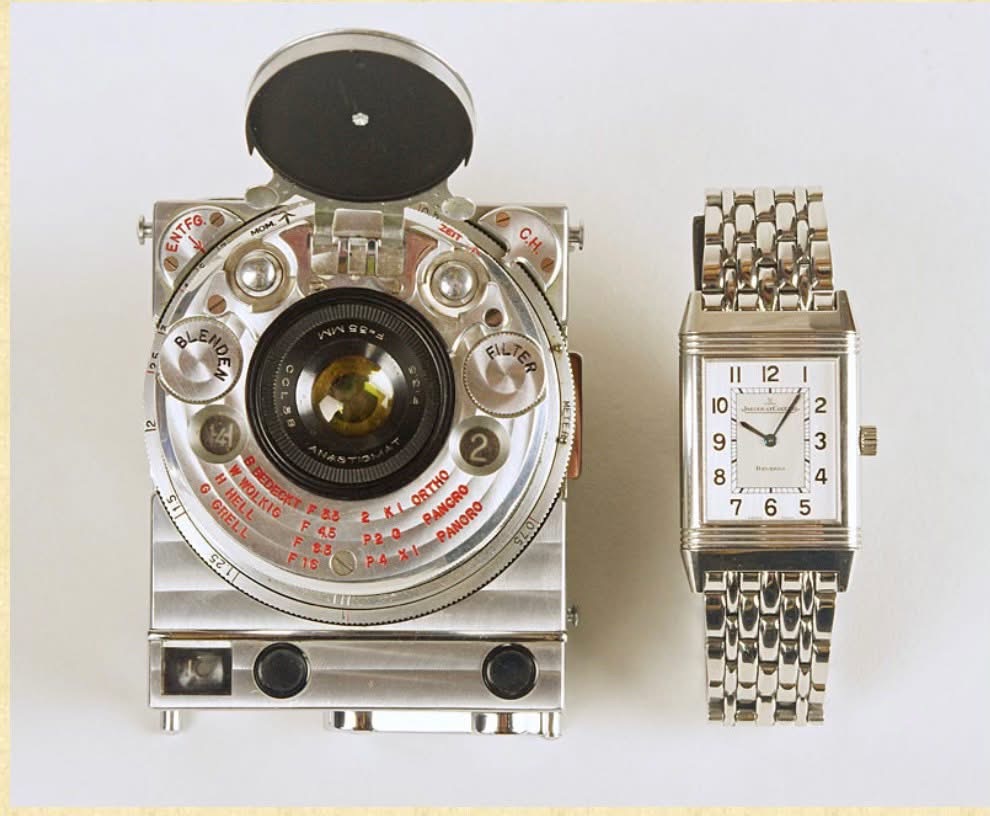
Did you know that Jaeger-LeCoultre made… a camera?
A watch measures time. A camera tries to stop it.
What if someone came up with the idea to combine both in the same object? And this was many years before the smartphone.
In the second half of the 1930s, the Compass Camera was created, a miniature camera produced by Jaeger-LeCoultre based on the idea of British inventor Noel Pemberton-Billing. It looked like elegant jewelry, worked like a serious tool, and was built… like a watch.
This project, of course, was not a solo effort. Jaeger-LeCoultre was responsible for the body, mechanics, and micro-springs, Kern & Co. supplied the lens, and Compass Cameras Ltd. handled the design and distribution. Inside the Compass, there were about 290 mechanical parts.
The body was made of solid aluminum, and the shutter was powered by a clockwork spring mechanism. And now for the best part: with dimensions of 7 × 5 cm and a weight of about 220 g (like a pack of cigarettes), the user had full control over the aperture from f/3.5 – f/16 and shutter speeds from 4.5 seconds to 1/500 s.
This was not just another gadget. It was a kind of manifesto of an era that believed precision could be miniaturized without losing its meaning, that mechanics reigned supreme, and watches were their embodiment.
The mechanical thinking of watchmakers was thus directly transferred to the world of photography. Without electronics, without shortcuts, without compromises. Everything was based on springs, gears, transmissions, and the constructor's patience.
Only a few thousand units were produced. Today, the Compass Camera is a rare collector's item, but for me, something else is more important: it's proof that watchmaking was never just about watches. It was, and still is, also about controlling time, whether we measure it with a hand or capture it with a snapping shutter.
My book will also be about such stories.
Not about rankings. Not about investments or advice like "the best watch for a banker." It's about ideas that escaped their own era, extraordinary people, and their often heroic feats, often against business reality.